CONSTITUENTS
Founding Documents — Constituents banner with the Federalist Papers, Declaration of Independence scroll, George Washington silhouette, and Independence Hall
Declaration of Independence (1776)
Declaration of Independence · July 4, 1776

The Declaration of Independence

America's Founding Creed

Summary

Adopted by the Second Continental Congress on July 4, 1776, the Declaration of Independence is America's founding creed. Drafted primarily by Thomas Jefferson with input from John Adams, Benjamin Franklin, and others, it announced the colonies' separation from Great Britain and asserted a revolutionary truth: that governments derive their just powers from the consent of the governed. It is not merely a legal document — it is a moral argument, a bill of indictment against King George III, and a statement of political philosophy that would echo through every American movement for freedom and equality that followed.

Key Themes & Wisdom

1
✨

All Men Are Created Equal

"We hold these truths to be self-evident, that all men are created equal, that they are endowed by their Creator with certain unalienable Rights..."

The Declaration's most famous line asserts that equality and rights are not gifts of government, but truths inherent to every person. Though the Founders fell short of this ideal in practice, the words became the moral standard against which every later expansion of American liberty would be measured.

2
🛡️

Unalienable Rights

"...Life, Liberty and the pursuit of Happiness."

Jefferson names three rights that cannot be surrendered or taken away. By placing "the pursuit of Happiness" alongside life and liberty, he broadened the purpose of government beyond mere security to the flourishing of the individual.

3
🤝

Consent of the Governed

"Governments are instituted among Men, deriving their just powers from the consent of the governed."

A government that rules without the consent of its people has no legitimate authority. This single sentence overturned the divine right of kings and established the principle that sovereignty rests with the people — the foundation of every American election since.

4
⚔️

The Right to Revolution

"When a long train of abuses and usurpations... evinces a design to reduce them under absolute Despotism, it is their right, it is their duty, to throw off such Government."

The Declaration does not merely declare independence — it justifies revolution. Jefferson argues that a people may rightfully overthrow a tyrannical government, but only after patient suffering and clear evidence of deliberate oppression. This is the moral case the document was written to make.

5
📜

A Bill of Indictment

"He has refused his Assent to Laws... He has obstructed the Administration of Justice... For imposing Taxes on us without our Consent."

The longest section of the Declaration is a list of 27 specific grievances against King George III — from dissolving colonial legislatures to quartering troops to cutting off trade. Jefferson catalogued these to prove that independence was not rash rebellion, but a last resort after repeated injury.

6
🇺🇸

A New Nation Declared

"These United Colonies are, and of Right ought to be Free and Independent States."

The final declaration dissolves all political ties with Britain and claims for the colonies the full powers of independent nations — to wage war, make peace, contract alliances, and establish commerce. With this, the United States of America was born.

Why It Matters Today

The Declaration of Independence is the promise America made to itself. Its words — that all are created equal and endowed with unalienable rights — have been invoked by every generation of Americans seeking to hold the nation to its own standard: by abolitionists, by suffragists, by civil rights marchers, by workers demanding fair treatment. The document did not abolish slavery, guarantee women the vote, or secure equality in 1776. But it gave future Americans the language and the moral leverage to demand that those realities eventually come. When we debate who counts as "the people," what rights are truly unalienable, or when a government has lost the consent of the governed, we are still arguing within the frame Jefferson built. The Declaration is not a finished answer — it is a question America keeps being asked.

independencenatural rightsconsent of the governedself-evident truthsunalienable rightstyrannyrevolutionlibertyequality
Thomas Jefferson (with John Adams & Benjamin Franklin) · July 4, 1776View source

Read the Original Document

(1 part)

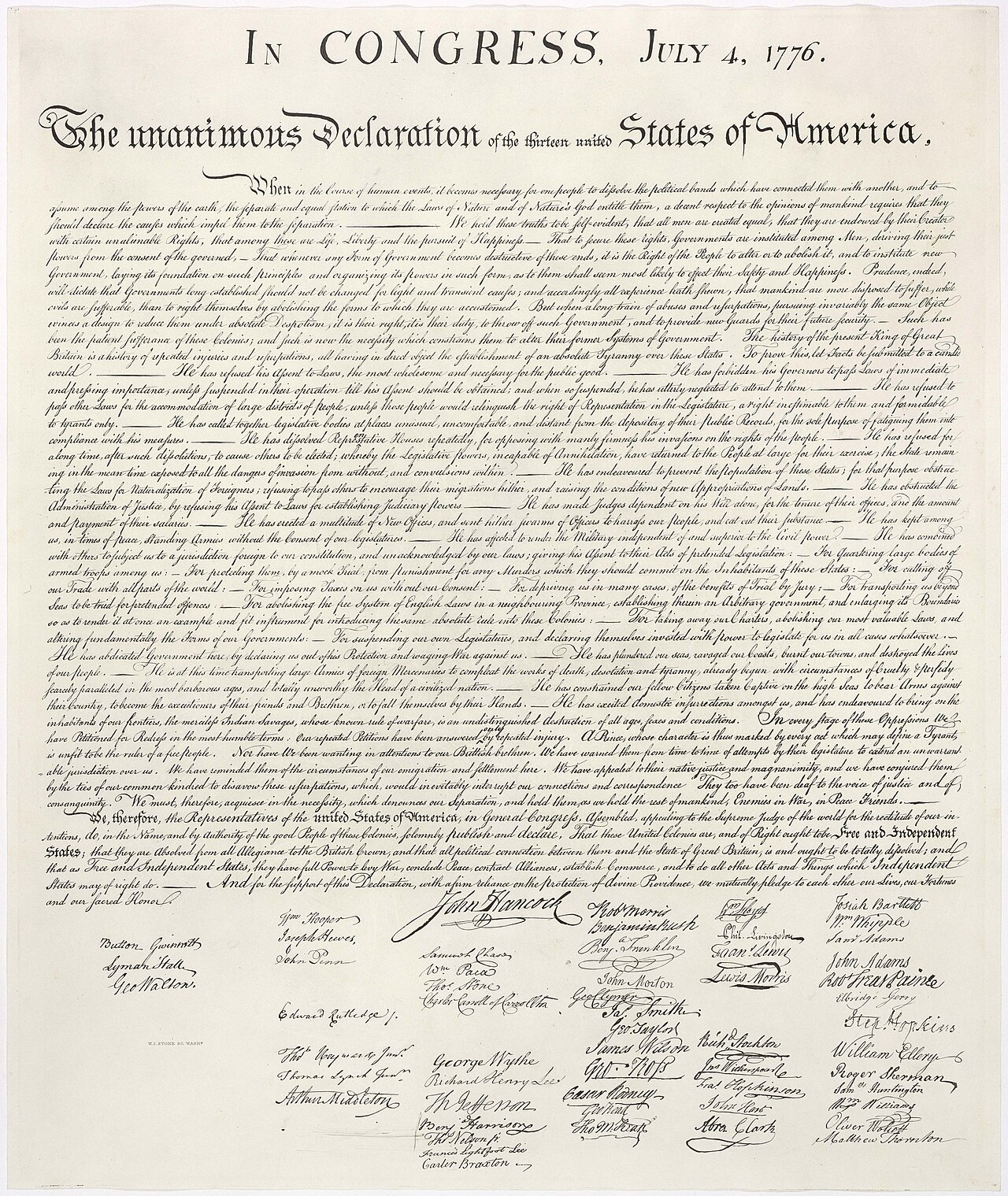
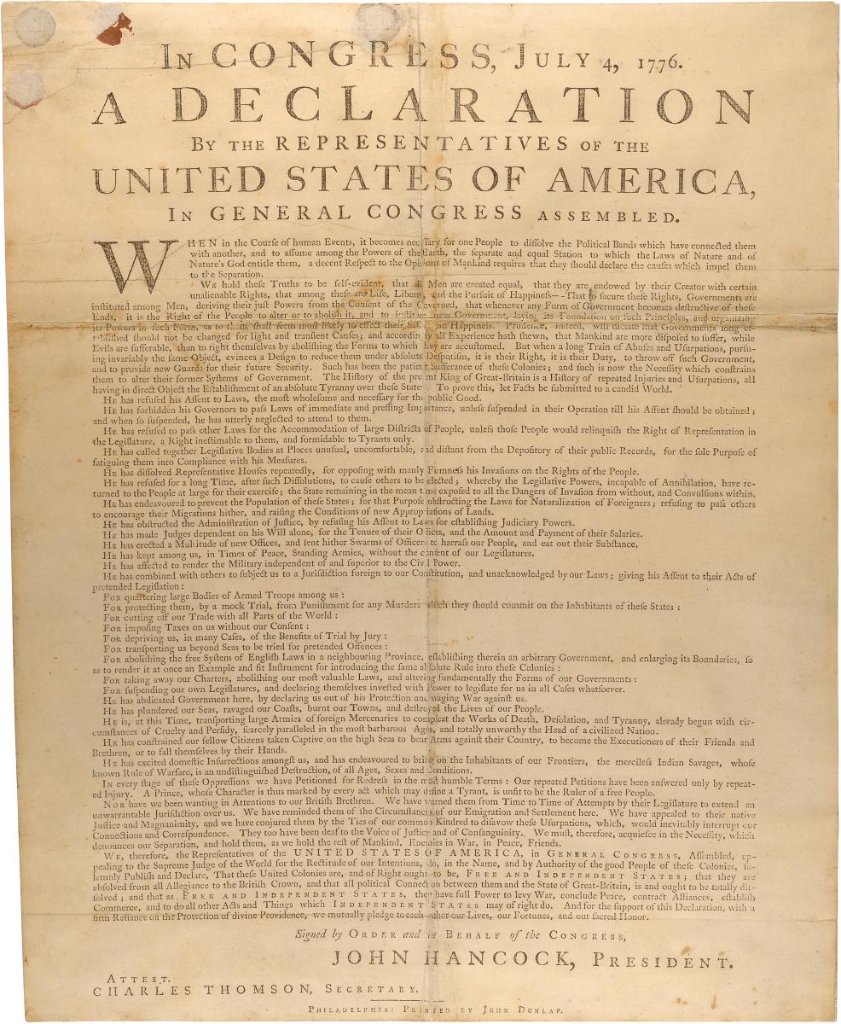
The Declaration of Independence, adopted on July 4, 1776, announced the thirteen American colonies' separation from Great Britain. It articulates the foundational principles of American democracy: that all people are created equal, endowed with unalienable rights to Life, Liberty, and the pursuit of Happiness, and that governments derive their just powers from the consent of the governed. When a government becomes destructive of these ends, the people have the right to alter or abolish it. The document lists 27 grievances against King George III and concludes with the formal declaration of independence.
In Congress, July 4, 1776 The unanimous Declaration of the thirteen united States of America, When in the Course of human events, it becomes necessary for one people to dissolve the political bands which have connected them with another, and to assume among the powers of the earth, the separate and equal station to which the Laws of Nature and of Nature's God entitle them, a decent respect to the opinions of mankind requires that they should declare the causes which impel them to the separation. We hold these truths to be self-evident, that all men are created equal, that they are endowed by their Creator with certain unalienable Rights, that among these are Life, Liberty and the pursuit of Happiness.--That to secure these rights, Governments are instituted among Men, deriving their just powers from the consent of the governed, --That whenever any Form of Government becomes destructive of these ends, it is the Right of the People to alter or to abolish it, and to institute new Government, laying its foundation on such principles and organizing its powers in such form, as to them shall seem most likely to effect their Safety and Happiness. Prudence, indeed, will dictate that Governments long established should not be changed for light and transient causes; and accordingly all experience hath shewn, that mankind are more disposed to suffer, while evils are sufferable, than to right themselves by abolishing the forms to which they are accustomed. But when a long train of abuses and usurpations, pursuing invariably the same Object evinces a design to reduce them under absolute Despotism, it is their right, it is their duty, to throw off such Government, and to provide new Guards for their future security.--Such has been the patient sufferance of these Colonies; and such is now the necessity which constrains them to alter their former Systems of Government. The history of the present King of Great Britain is a history of repeated injuries and usurpations, all having in direct object the establishment of an absolute Tyranny over these States. To prove this, let Facts be submitted to a candid world. He has refused his Assent to Laws, the most wholesome and necessary for the public good. He has forbidden his Governors to pass Laws of immediate and pressing importance, unless suspended in their operation till his Assent should be obtained; and when so suspended, he has utterly neglected to attend to them. He has refused to pass other Laws for the accommodation of large districts of people, unless those people would relinquish the right of Representation in the Legislature, a right inestimable to them and formidable to tyrants only. He has called together legislative bodies at places unusual, uncomfortable, and distant from the depository of their public Records, for the sole purpose of fatiguing them into compliance with his measures. He has dissolved Representative Houses repeatedly, for opposing with manly firmness his invasions on the rights of the people. He has refused for a long time, after such dissolutions, to cause others to be elected; whereby the Legislative powers, incapable of Annihilation, have returned to the People at large for their exercise; the State remaining in the mean time exposed to all the dangers of invasion from without, and convulsions within. He has endeavoured to prevent the population of these States; for that purpose obstructing the Laws for Naturalization of Foreigners; refusing to pass others to encourage their migrations hither, and raising the conditions of new Appropriations of Lands. He has obstructed the Administration of Justice, by refusing his Assent to Laws for establishing Judiciary powers. He has made Judges dependent on his Will alone, for the tenure of their offices, and the amount and payment of their salaries. He has erected a multitude of New Offices, and sent hither swarms of Officers to harrass our people, and eat out their substance. He has kept among us, in times of peace, Standing Armies without the Consent of our legislatures. He has affected to render the Military independent of and superior to the Civil power. He has combined with others to subject us to a jurisdiction foreign to our constitution, and unacknowledged by our laws; giving his Assent to their Acts of pretended Legislation: For Quartering large bodies of armed troops among us: For protecting them, by a mock Trial, from punishment for any Murders which they should commit on the Inhabitants of these States: For cutting off our Trade with all parts of the world: For imposing Taxes on us without our Consent: For depriving us in many cases, of the benefits of Trial by Jury: For transporting us beyond Seas to be tried for pretended offences: For abolishing the free System of English Laws in a neighbouring Province, establishing therein an Arbitrary government, and enlarging its Boundaries so as to render it at once an example and fit instrument for introducing the same absolute rule into these Colonies: For taking away our Charters, abolishing our most valuable Laws, and altering fundamentally the Forms of our Governments: For suspending our own Legislatures, and declaring themselves invested with power to legislate for us in all cases whatsoever. He has abdicated Government here, by declaring us out of his Protection and waging War against us. He has plundered our seas, ravaged our Coasts, burnt our towns, and destroyed the lives of our people. He is at this time transporting large Armies of foreign Mercenaries to compleat the works of death, desolation and tyranny, already begun with circumstances of Cruelty & perfidy scarcely paralleled in the most barbarous ages, and totally unworthy the Head of a civilized nation. He has constrained our fellow Citizens taken Captive on the high Seas to bear Arms against their Country, to become the executioners of their friends and Brethren, or to fall themselves by their Hands. He has excited domestic insurrections amongst us, and has endeavoured to bring on the inhabitants of our frontiers, the merciless Indian Savages, whose known rule of warfare, is an undistinguished destruction of all ages, sexes and conditions. In every stage of these Oppressions We have Petitioned for Redress in the most humble terms: Our repeated Petitions have been answered only by repeated injury. A Prince, whose character is thus marked by every act which may define a Tyrant, is unfit to be the ruler of a free people. Nor have We been wanting in attentions to our Brittish brethren. We have warned them from time to time of attempts by their legislature to extend an unwarrantable jurisdiction over us. We have reminded them of the circumstances of our emigration and settlement here. We have appealed to their native justice and magnanimity, and we have conjured them by the ties of our common kindred to disavow these usurpations, which, would inevitably interrupt our connections and correspondence. They too have been deaf to the voice of justice and of consanguinity. We must, therefore, acquiesce in the necessity, which denounces our Separation, and hold them, as we hold the rest of mankind, Enemies in War, in Peace Friends. We, therefore, the Representatives of the united States of America, in General Congress, Assembled, appealing to the Supreme Judge of the world for the rectitude of our intentions, do, in the Name, and by Authority of the good People of these Colonies, solemnly publish and declare, That these United Colonies are, and of Right ought to be Free and Independent States; that they are Absolved from all Allegiance to the British Crown, and that all political connection between them and the State of Great Britain, is and ought to be totally dissolved; and that as Free and Independent States, they have full Power to levy War, conclude Peace, contract Alliances, establish Commerce, and to do all other Acts and Things which Independent States may of right do. And for the support of this Declaration, with a firm reliance on the protection of divine Providence, we mutually pledge to each other our Lives, our Fortunes and our sacred Honor. Georgia: Button Gwinnett, Lyman Hall, George Walton North Carolina: William Hooper, Joseph Hewes, John Penn South Carolina: Edward Rutledge, Thomas Heyward, Jr., Thomas Lynch, Jr., Arthur Middleton Massachusetts: John Hancock Maryland: Samuel Chase, William Paca, Thomas Stone, Charles Carroll of Carrollton Virginia: George Wythe, Richard Henry Lee, Thomas Jefferson, Benjamin Harrison, Thomas Nelson, Jr., Francis Lightfoot Lee, Carter Braxton Pennsylvania: Robert Morris, Benjamin Rush, Benjamin Franklin, John Morton, George Clymer, James Smith, George Taylor, James Wilson, George Ross Delaware: Caesar Rodney, George Read, Thomas McKean New York: William Floyd, Philip Livingston, Francis Lewis, Lewis Morris New Jersey: Richard Stockton, John Witherspoon, Francis Hopkinson, John Hart, Abraham Clark New Hampshire: Josiah Bartlett, William Whipple, Matthew Thornton Massachusetts: Samuel Adams, John Adams, Robert Treat Paine, Elbridge Gerry Rhode Island: Stephen Hopkins, William Ellery Connecticut: Roger Sherman, Samuel Huntington, William Williams, Oliver Wolcott New Hampshire: Matthew Thornton
Complete textView source

Ask About This Document

"Liberty cannot be preserved without general knowledge among the people."

— John Adams

© 2025 Constituents. Empowering civic engagement and transparency.

CONSTITUENTS
Constituents — A Republic If We Can Keep It

A Republic If We Can Keep It

Welcome to Constituents


Disclaimer

Constituents provides information synthesized from public government sources, official records, and publicly available data. All content is for informational purposes only and should not be considered legal, financial, or professional advice.

We strive for accuracy but cannot guarantee every detail is error-free. Data may change rapidly. Users should verify important information directly from official sources.

The app and its AI summaries represent no official opinion or endorsement by any government entity, political party, or individual. Any perceived bias is unintentional.

Use at your own risk.

Create Account

Already have an account? Sign in

Browse as a guest. Explore all tabs — legislation, representatives, live floor activity, news, founding documents, and more. Create an account to personalize your feed, vote on bills, and contact your representatives directly.