The Amendments
Twenty-seven changes to the Constitution; who argued for them, how they were ratified, and what the text now requires.
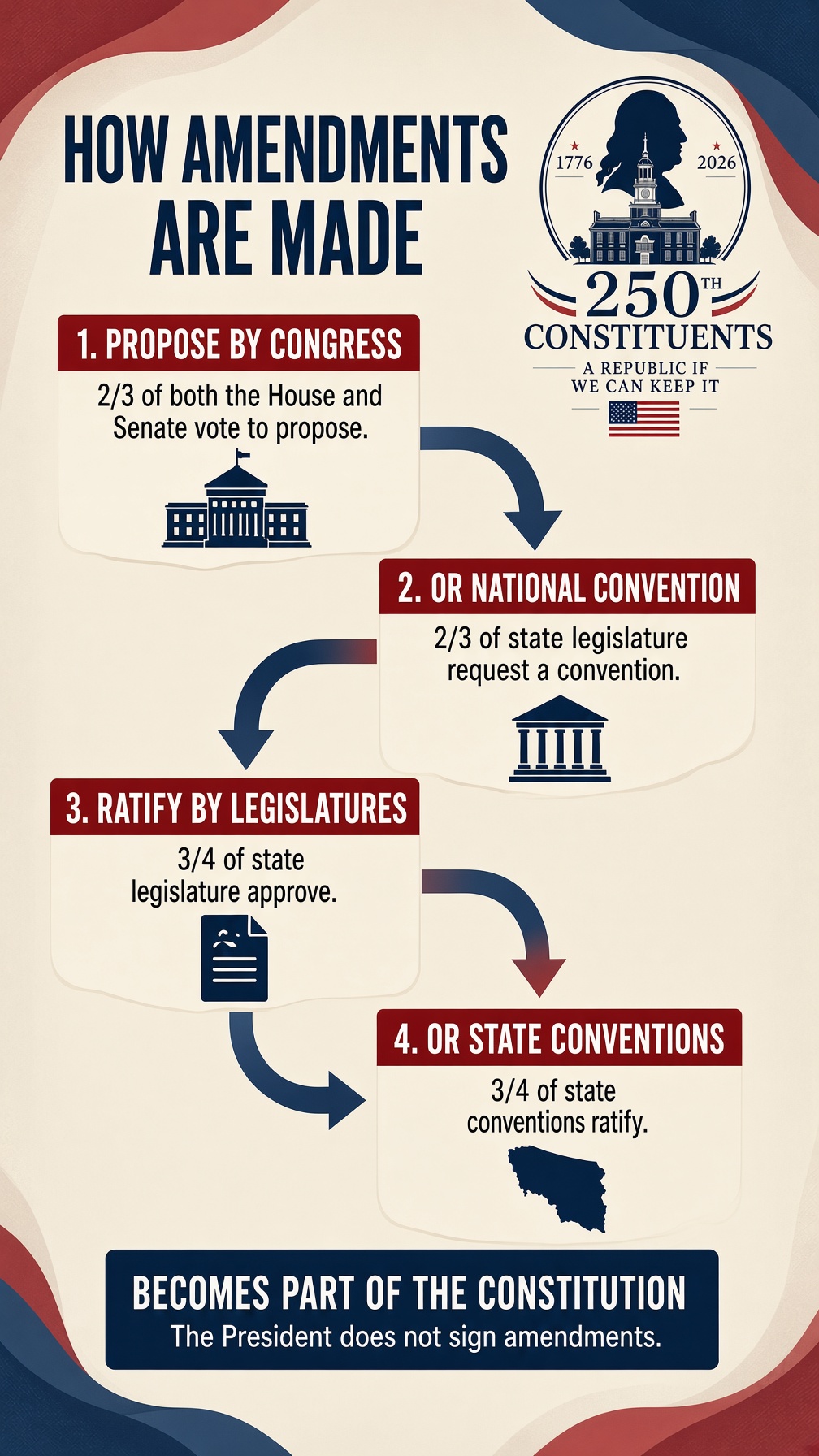
Historical Example · Propose by Congress
Every one of the 27 amendments was proposed this way. The 27th (congressional pay) was introduced by James Madison in 1789 and ratified 203 years later, in 1992.
Tap a step to glow it and reveal how it played out in history.
The first ten amendments were added in 1791 because many Americans would not trust a new federal government without written limits. Madison wrote them. Mason, Henry, Jefferson, and the ratifying conventions made them unavoidable.
Bill of Rights · Amendments I–X
Official text
Congress shall make no law respecting an establishment of religion, or prohibiting the free exercise thereof; or abridging the freedom of speech, or of the press; or the right of the people peaceably to assemble, and to petition the Government for a redress of grievances.
In plain English
The federal government cannot set up an official church, stop you from practicing your faith, silence your speech or writing, or stop you from gathering to ask the government to fix something.
Why it was added
Many states would not ratify the Constitution without written guarantees that the new federal government could not touch basic freedoms. Anti-Federalists demanded these limits before they would agree to the new union.
Who pushed it
Where you still see it
- • A newspaper publishing criticism of an elected official.
- • People gathering in a public square to protest a law.
Related in the app
Ratified December 15, 1791.
Later Amendments · XI–XXVII
Official text from the National Archives. A republic — if you can keep it.